


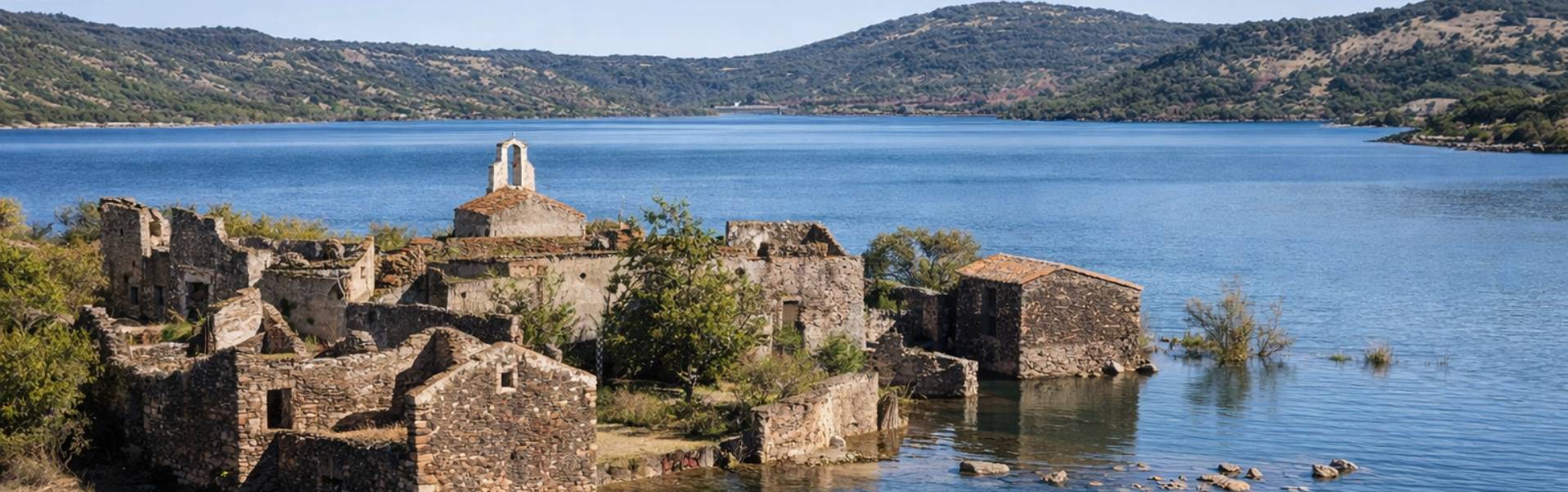
You’ve heard the story of a village sunk beneath the waters of Lac du Salagou and you’re trying to sort out what’s real and what’s not? The story is more nuanced than it seems. Celles, a small hamlet in the Hérault region, was supposed to be submerged when the dam was impounded in the 1960s. But the planned level was never reached. The result: a ghost village on the edge of the lake, neither quite sunken nor really alive for decades. Discover it just 15 kilometers from our lakeside Campsite in Hérault!
Key points to remember
- Celles is the village associated with the legend of the sunken village of Lac du Salagou, but it was never submerged.
- Its 80 inhabitants were expropriated in the 1960s to build the dam.
- The predicted water level (150 m) was never reached: the village, located at an altitude of 143 m, remained above water.
- Abandoned for decades, Celles is now enjoying a renaissance thanks to an ambitious rehabilitation project.
- The site is part of the Salagou-Cirque de Mourèze Grand Site de France, which will be awarded the label in 2024.
Why is there talk of a sunken village on Lac du Salagou?
The expression “the sunken village of Lac du Salagou” has entered the collective imagination, but it’s based on a more subtle reality. In the 1950s, the Hérault department launched a vast dam project in the Salagou valley. The aim was to create a water reserve to irrigate fruit crops and regulate flooding of the Lergue and Hérault rivers. Winegrowing, then in overproduction, was to give way to orchards.
The village of Celles, located in this valley of red volcanic soil, lies directly on the area to be flooded. The plan was to raise the lake level to 150 meters. Celles, however, lies at an altitude of 143 metres. The fate of the village seemed sealed.
Expropriation: when residents had to leave everything behind
In 1959, the project was declared to be in the public interest. The 80 inhabitants of Celles, most of them farmers, were forced to sell their land and houses to the département. One by one, families left this hamlet of volcanic stone, taking with them centuries of rural history.
Impoundment of the dam began in 1969. The waters gradually rose in the valley, drowning roads, paths and agricultural plots. Everyone expected Celles to disappear beneath the surface.
A tip from the Campsite team: if you walk along the shores of Lac du Salagou in summer, when the water level drops slightly, you can see ancient low walls and paths emerging from the red water.
The miracle of Celles: a village spared by the waters
Against all expectations, the Lac du Salagou never reached the famous cote 150. The level stabilized at around 139 metres, well below the village’s altitude. Celles remained dry, its feet in the water but its head above the waves. Plans for a second phase of filling are gradually abandoned.
The paradox is cruel: the inhabitants have been expropriated and relocated for nothing. The village, emptied of its occupants, is gradually falling into ruin. Houses were squatted, roofs collapsed and vegetation took over. For decades, Celles became a ghost village, frozen between abandonment and memory.
The rebirth of the sunken village of Salagou
The story of the sunken village of Lac du Salagou could have ended there. But in 1995, a young mayor, Joëlle, took over the reins of this atypical commune, which had retained only twenty or so voters. Only the church, town hall and square had been restored.
And so began a long battle to bring Celles back to life. The mayor obtained maintenance of the access road, then funding to launch a genuine rehabilitation project. The turning point came in 2010, when the département handed over full ownership of the village to the commune.
Today, the renaissance project is based on strong principles: social and intergenerational diversity, permanent professional activities and respect for the built heritage. By 2025, three houses will have been fully renovated, and an endowment fund has been set up to oversee the operation. The village’s ultimate target is 85 inhabitants.
Visit Celles: what can you see at the sunken village of Salagou?
Whether you’re a history or geology buff, or simply curious, a visit to Celles is well worth the detour during your stay on the shores of Lac du Salagou.
- The chapel and medieval streets: red volcanic stone facades bear witness to traditional local architecture.
- The geological lookout: a viewpoint listed by Hérault Tourisme, offering a panoramic view of the lake and the red ruffe formations.
- The banks of the lake: directly accessible from the village, they allow you to see how close the water is to the first houses.
- Renovation projects: some are visible from the outside and bear witness to the renewal underway.
Visitors’ favorite: the contrast between the dark stone ruins and the red earth around the lake creates an almost unreal atmosphere. It’s like being on another planet. Arrive early in the morning to enjoy the calm and the reflections on the water.
What to do around Lac du Salagou after your visit?
Lac du Salagou and the surrounding area provide an ideal playground for extending your discovery of the area after a visit to the village. Swimming, hiking, mountain biking or simply strolling: there’s no shortage of possibilities.
The tour of the lake on foot (approx. 28 km) or by mountain bike allows you to discover the ruffe landscapes and panoramic views of the cirque de Mourèze. For a shorter version, the Mont Liausson hike offers a lovely view of the whole site. Heritage lovers will appreciate the nearby villages of Mourèze, Octon and Villeneuvette, each with its own character.
To make the most of your visit to the sunken village and the whole of the Grand Site, the best option is to set down your suitcases nearby. Our 4-star Campsite is located right on the edge of the lake, in the heart of this Natura 2000 listed landscape. With direct access to the water, a heated pool area and accommodation ranging from mobile homes to chalets, it’s the ideal base from which to discover Celles and the wonders of the surrounding area, with its volcanic soils and picturesque villages.
Book now!
FAQ – The sunken village of Lac du Salagou
When is the best time to visit the sunken village of Salagou?
The best time to visit Celles and Lac du Salagou is spring or early autumn. Temperatures are pleasant, visitor numbers are lower than in summer and the low-angled light enhances the colors of the red earth. In summer, early mornings are best to avoid the heat.
How do I get to the village of Celles from the Lac du Salagou Campsite?
The village of Celles is 15 kilometers from our Campsite, about 20 minutes away. You can also get there by bike or on foot along the banks of the river, a walk that takes about an hour.
Sources :
- Hérault Tourisme – The Lac du Salagou: planet Mars: https://www.herault-tourisme.com/fr/decouvrir/nos-incontournables/lac-du-salagou/
- France Bleu – “Celles et ceux”, the documentary that follows the rebirth of the ghost hamlet: https://www.francebleu.fr/infos/culture-loisirs/celles-et-ceux-le-documentaire-qui-suit-la-renaissance-du-hameau-de-celles-au-bord-du-lac-du-salagou-1611251448
- Grand Site de France – The Salagou-Cirque de Mourèze obtains the label: https://www.grandsitedefrance.com/actus/761-label-salagou-moureze
- Mairie de Celles – A lively village: https://mairie-celles.fr/?unVillageVivant=